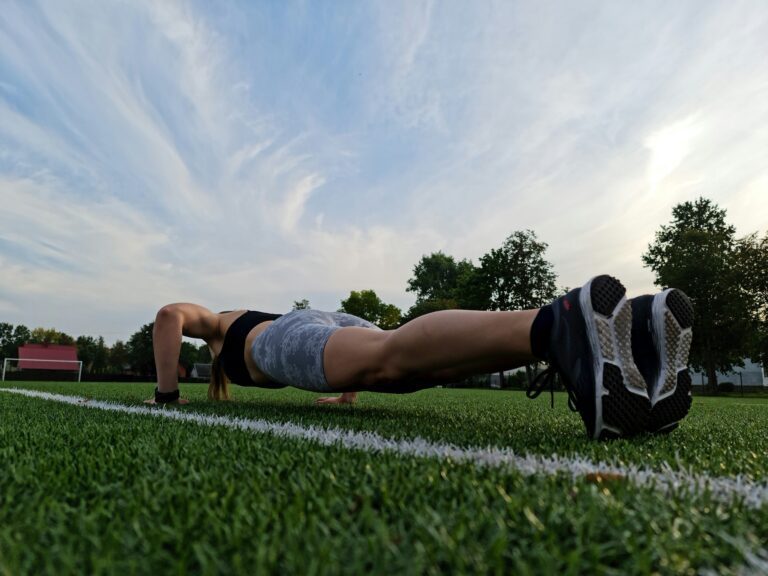
When most people think about pushups, they picture an exercise for building a stronger chest, shoulders and arms. But there’s more happening during every repetition. Pushups also work your core muscles, helping you maintain stability, control your body position and move efficiently.
So, can pushups strengthen your abs? And are they enough for a strong core without additional abdominal exercises? Let’s take a closer look.
Do Pushups Really Work Your Abs?
Yes. Although pushups primarily target your chest, shoulders and triceps, they also recruit muscles throughout your abdomen and torso. Think of a pushup as a moving plank: your arms bend and straighten while your body stays relatively straight from head to heels.
Your core works to prevent your hips from sagging, your lower back from arching excessively and your body from twisting.
- Rectus abdominis: Helps resist excessive lower-back arching.
- Transverse abdominis: A deep abdominal muscle contributing to trunk stability.
- Internal and external obliques: Help resist unwanted rotation.
- Erector spinae: Support the spine alongside your abdominal muscles.
Unlike a traditional situp, where the torso moves through a substantial range of motion, your abdominal muscles work mostly isometrically during a standard pushup: they produce force while your trunk remains relatively still.
Why Core Strength Matters for Better Pushups
Have you ever started a set with good form, only to notice your hips dropping as you become tired? Maintaining trunk stability is becoming difficult. Your core connects your upper and lower body and helps you perform consistent repetitions.
- Maintain a relatively straight body position.
- Reduce excessive movement through the lower back.
- Keep repetitions controlled and consistent.
- Preserve technique as fatigue develops.
This becomes especially important when working toward 50 or even 100 consecutive pushups. Your chest and triceps may have strength left, but if you can no longer maintain alignment, it’s time to rest. Quality repetitions matter more than extra repetitions with poor form.
How to Engage Your Core During Pushups
1. Establish a Strong Starting Position
Place your hands approximately shoulder-width apart or slightly wider, extend your legs behind you and form a relatively straight line from head to heels. Avoid excessively raised or sagging hips.
2. Brace Your Abdominal Muscles
Gently tighten your abdomen as though preparing for a light poke in the stomach. Keep breathing normally.
3. Keep Your Glutes Engaged
Gently contracting your glutes can help prevent excessive arching through your lower back.
4. Lower Yourself With Control
Bend your elbows and lower your chest toward the floor without letting your hips drop ahead of your shoulders. For more technique advice, see our guide to perfecting your pushup form.
5. Push Back Up as One Unit
Press through your hands until your arms extend, keeping your shoulders and hips rising together. If this is difficult, try incline pushups with your hands on a sturdy bench or countertop.
Three Pushup Variations That Challenge Your Core
1. Slow-Tempo Pushups
Take approximately three seconds to lower yourself before pressing back up. The slower movement increases the time your muscles spend supporting your body. Try: 2–3 sets of 6–10 controlled repetitions.
2. Staggered-Hand Pushups
Move one hand slightly forward of the other and perform controlled pushups while resisting torso rotation. Switch hand positions between sets. Try: 2 sets of 5–8 repetitions with each hand position.
3. Pushup to Shoulder Tap
After each pushup, briefly lift one hand to touch the opposite shoulder, then alternate. Keep your hips as still as possible. Try: 2 sets of 6–10 pushups, alternating taps. Widen your feet or return to standard pushups if your hips twist excessively.
For a different comparison, see our article on pushups versus planks for core training.
Are Pushups Enough to Build a Strong Core?
Pushups contribute to core strength, but they need not be your only abdominal exercise. During a standard pushup, the core primarily resists movement. Other exercises can challenge your torso through different positions and actions.
- Front plank: Maintain trunk stability.
- Side plank: Resist sideways bending.
- Dead bug: Control trunk position while moving your limbs.
- Bird dog: Stabilize while extending opposite arm and leg.
- Situps: Train repeated trunk and hip flexion.
You don’t need all of these in every workout. Pairing pushups with two or three complementary core exercises is a useful starting point.
Should You Combine Pushups and Situps?
Pushups and situps challenge your abdominal muscles differently. Pushups emphasize keeping the trunk stable while the arms move; situps involve repeated torso and hip flexion, placing different demands on the abdominal muscles and hip flexors.
More repetitions aren’t automatically better. Hundreds of situps every day aren’t necessary for core strength, and high repetition counts may be unsuitable for some people, particularly if they experience back or neck discomfort.
For a closer look at the benefits, limitations and recovery considerations, read our guide to doing 200 situps a day. Choose exercises you can perform comfortably and consistently, and allow adequate recovery.
A Simple Pushup and Core Workout
Here’s a straightforward workout combining upper-body strength with core stability:
| Exercise | Sets | Repetitions or duration |
|---|---|---|
| Standard pushups | 3 | 8–15 reps |
| Front plank | 2 | 20–40 seconds |
| Dead bug | 2 | 8–10 per side |
| Side plank | 2 | 15–30 seconds per side |
Rest approximately 45–90 seconds between sets, or longer if needed. Adjust the repetitions to your level, using incline pushups if standard pushups are too difficult. Try the workout two or three times weekly, with recovery between challenging sessions.
Building Toward 100 Pushups
If your goal is 100 consecutive pushups, good core control matters. As your repetitions increase, pay attention to whether you can maintain the same alignment near the end of your set as at the beginning.
Our Hundred Pushups training program offers a progressive approach to building pushup strength and endurance over time.
The Bottom Line: Pushups Are a Core Exercise, Too
Pushups may be best known for strengthening the chest, shoulders and triceps, but your abdominal muscles help stabilize your torso during every repetition. Will pushups strengthen your core? Yes, particularly with consistent practice, sound technique and appropriate progression.
For more complete core development, combine pushups with other exercises that challenge your abdomen in different ways. Whether you’re aiming for 10 pushups or 100, prioritize good technique over chasing a bigger number.