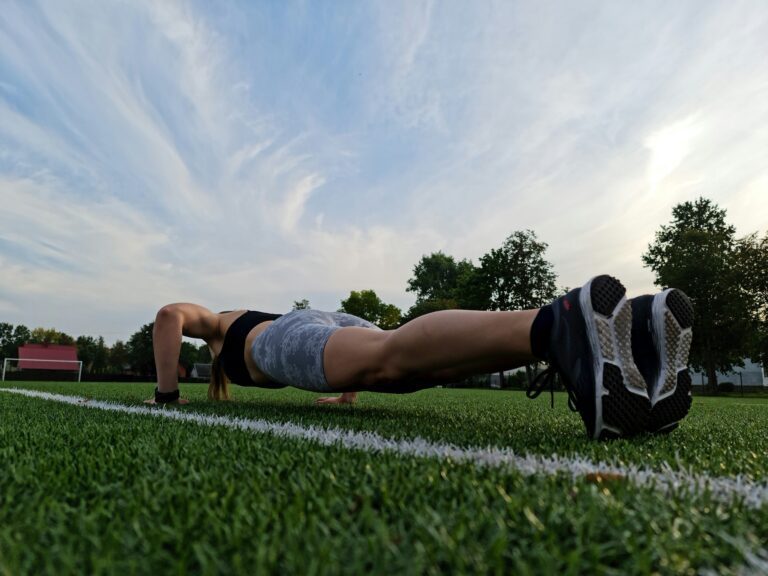
Traveling can make it difficult to maintain a regular exercise routine. Whether you’re away on business, enjoying a holiday or spending hours in airports, your usual gym and equipment may be unavailable.
Fortunately, you don’t need a fully equipped gym to maintain upper-body strength. Push-ups are one of the most convenient exercises for travelers. They require no equipment, take up very little space and can be adapted to almost any fitness level.
In this guide, you’ll find a 10-minute hotel-room workout, a 15-minute full-body routine and practical ways to maintain your push-up progress away from home.
Why Push-Ups Are Ideal for Travel
- No equipment required: All you need is enough space to lie down.
- Quick workouts: Even a short session can provide a useful strength-training stimulus.
- Flexible difficulty: Beginners can use incline push-ups, while experienced exercisers can try harder variations.
- Full-body involvement: Push-ups work the chest, shoulders and triceps while the core and glutes stabilize the body.
- Easy to track: Record sets and repetitions without specialist equipment.
The key is choosing a routine that fits your schedule rather than trying to recreate every detail of your normal workouts.
The 10-Minute Hotel-Room Push-Up Workout
Best for: Busy mornings, business trips and days when you have very little time. This routine combines push-ups with lower-body and core exercises.
Warm-Up — 2 Minutes
- 30 seconds of marching in place.
- 30 seconds of arm circles.
- 30 seconds of bodyweight squats.
- 30 seconds of shoulder rolls and controlled arm movements.
Main Workout — 6 Minutes
Perform the following three-exercise circuit twice. Each exercise takes 40 seconds, followed by exactly 20 seconds of rest or transition. That makes each round 3 minutes and both rounds 6 minutes.
| Exercise | Work | Rest/transition |
|---|---|---|
| Standard or incline push-ups | 40 seconds | 20 seconds |
| Bodyweight squats | 40 seconds | 20 seconds |
| Forearm plank | 40 seconds | 20 seconds |
Repeat the circuit once more, including the 20-second rest after the final plank. Timing: 2-minute warm-up + 6-minute circuit + 2-minute cooldown = exactly 10 minutes. Choose a push-up variation that allows good technique; pause briefly within a work interval if needed.
Cooldown — 2 Minutes
Finish with gentle shoulder, chest and upper-body movements. Beginner modification: Perform incline push-ups against a stable countertop or other secure surface. Advanced modification: Try slow-tempo push-ups or a controlled pause near the bottom.
The 15-Minute Full-Body Travel Workout
Best for: Days when you have a little more time and want a broader workout. Push-ups are useful for upper-body strength, but they shouldn’t be your only exercise.
Warm-Up — 3 Minutes
Perform light marching, arm circles, squats and gentle mobility exercises for three minutes.
Main Workout — 10 Minutes
Complete two rounds of the following exercises. Work at a controlled pace, resting briefly as needed. Use the 10-minute block for the circuit; if you finish early, recover rather than adding unnecessary repetitions.
| Exercise | Repetitions or duration |
|---|---|
| Push-ups | 8–15 repetitions |
| Bodyweight squats | 15 repetitions |
| Reverse lunges | 8 per leg |
| Forearm plank | 30 seconds |
| Glute bridges | 12–15 repetitions |
If you cannot finish two rounds within ten minutes while maintaining good technique, complete fewer repetitions or one round instead.
Cooldown — 2 Minutes
Finish with gentle stretching or relaxed movement. Total session time: 3-minute warm-up + 10-minute workout block + 2-minute cooldown = 15 minutes.
Five Push-Up Variations That Work Well While Traveling
1. Standard Push-Ups
The classic option for upper-body strength and muscular endurance. Maintain a straight body position and lower under control.
2. Incline Push-Ups
Place your hands on a sturdy, stable elevated surface to reduce the load. Avoid rolling chairs, lightweight tables or anything that could slide.
3. Close-Grip Push-Ups
Bring your hands slightly closer together to increase the triceps challenge. Keep your wrists comfortable.
4. Slow-Tempo Push-Ups
Lower over approximately three seconds before pressing back up. This increases the challenge without extra equipment.
5. Push-Up to Shoulder Tap
After each push-up, touch one hand to the opposite shoulder. Alternate sides while keeping your hips stable.
For more options, read our guide to 10 push-up variations.
How to Exercise in a Small Hotel Room
Most push-up workouts require only enough space to extend your body comfortably.
- Choose a safe surface: Use a stable floor with adequate grip; make sure towels or mats won’t slide.
- Clear obstacles: Move luggage, cables and other items out of the way.
- Avoid unstable furniture: Rolling chairs and lightweight tables aren’t suitable for incline push-ups.
- Keep noise down: Controlled bodyweight movements are more considerate than jumping exercises.
- Adapt to the space: Substitute stationary squats or glute bridges if lunges aren’t practical.
How to Maintain Push-Up Progress While Traveling
Keep Some Consistency
Try two or three push-up sessions per week if your schedule and recovery allow. During demanding travel days, fewer sets may be appropriate.
Maintain Good Technique
Focus on controlled repetitions instead of trying to beat your previous best every session. Quality matters more than rushing through a high count.
Adjust Your Expectations
Travel can affect sleep, hydration and energy levels. It’s reasonable to reduce training volume temporarily.
Track Your Repetitions
Use a phone or notebook to record the push-up variation, sets, repetitions, how hard the session felt and any adjustments. These notes help you resume regular training.
Resume Gradually
After a long trip, don’t immediately attempt your hardest workout if you’ve been inactive or fatigued. Return progressively. If you’re aiming for 100 consecutive push-ups, the Hundred Pushups training program offers a structured progression.
What About Push-Ups During Long Travel Days?
Long flights and car journeys can leave you stiff and tired. Rather than attempting push-ups in an airport lounge, take walking breaks when practical, use stairs where convenient, do gentle shoulder movements or complete a brief workout after reaching your accommodation. After an exhausting day, walking or mobility work may be more appropriate than a hard strength session.
Can You Build Strength With Just Push-Ups While Traveling?
Push-ups can help maintain or improve upper-body strength if the difficulty is appropriate and increases progressively. However, they aren’t a complete strength program. Combine them with exercises for your legs and trunk and, when possible, your back. Squats, lunges, planks and glute bridges are convenient additions.
For more on the abdominal muscles involved, see Do Pushups Strengthen Your Core?
Frequently Asked Questions
How many push-ups should I do while traveling?
That depends on your ability. Beginners might start with two or three sets of incline push-ups; experienced exercisers can use standard or harder variations. Maintain proper form.
Is a 10-minute hotel-room workout enough?
A short workout helps maintain consistency when time is limited. Whether it’s enough for broader fitness goals depends on your usual training, intensity and overall activity.
Can I do push-ups every day on holiday?
Light practice may be manageable frequently, but demanding sessions require recovery. Rest when soreness or fatigue affects technique.
Do I need to bring exercise equipment?
No specialist equipment is required for these workouts. A safe, comfortable floor surface is sufficient.
Will I lose strength during a week away?
A brief reduction in training doesn’t automatically mean meaningful strength loss. Stay reasonably active, and don’t compensate for missed sessions with excessive repetitions.
Final Thoughts: Stay Consistent, Wherever You Go
Travel doesn’t have to stop your fitness routine. Push-ups are simple, adaptable and convenient for hotel rooms, holidays and business trips. Whether you have 10 or 15 minutes, a short bodyweight workout can help maintain consistency. The goal isn’t to train perfectly while traveling. It’s to make staying active easy enough that you can keep doing it.